
Made in Poland
Global Shipping
Engineering & Drive Technology

Three drive technologies. One platform family.

One supplier, three drive architectures - ball screws (TL), helical-bevel crank-arms (TM), an integrated cockpit (QS). This page helps pick the right one for the build.

At a glance

Three platforms, one family.

The Linear hexapod, the Low-Profile crank-arm and the Qubic cockpit are three mechanical answers to the same question. Each solves a different constraint - payload, profile, or integration speed - all backed by one in-house engineering team and SDK support after delivery. The Linear (TL) and Low-Profile (TM) lines together make up the Professional Series; the Qubic System (QS) is the plug-and-play line.

Linear Series
TL · Linear Series

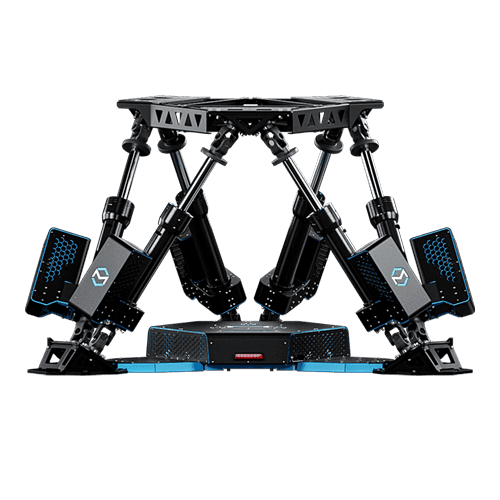
The hexapod built for the heaviest, stiffest work.

Six ball-screw actuators on a Stewart base carry up to 1350 kg of cabin through over 505 mm of vertical heave with tight, repeatable tracking. Built for integrator-certified flight training devices, vehicle dynamics labs and maritime cues that depend on raw amplitude.

Payload
150-1350 kg
DOF
6
Heave
505+ mm
Explore TL Series
Low-Profile Series
TM · Low-Profile Series

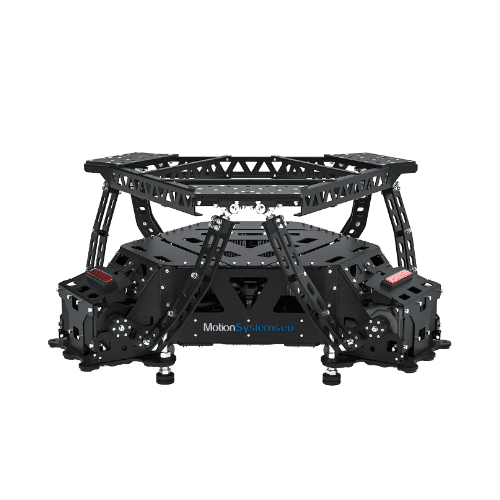
The low-ceiling alternative.

Motors sit horizontally beside each actuator, so the resting profile starts as low as 337 mm - markedly lower than a comparable hexapod. Eight models scale the same crank-arm mechanism from 150 kg entry rigs through 6DOF / 1500 kg.

Payload
150-1500 kg
DOF
3-6
Profile
from 337 mm
Explore TM Series
Qubic System
QS · Qubic System

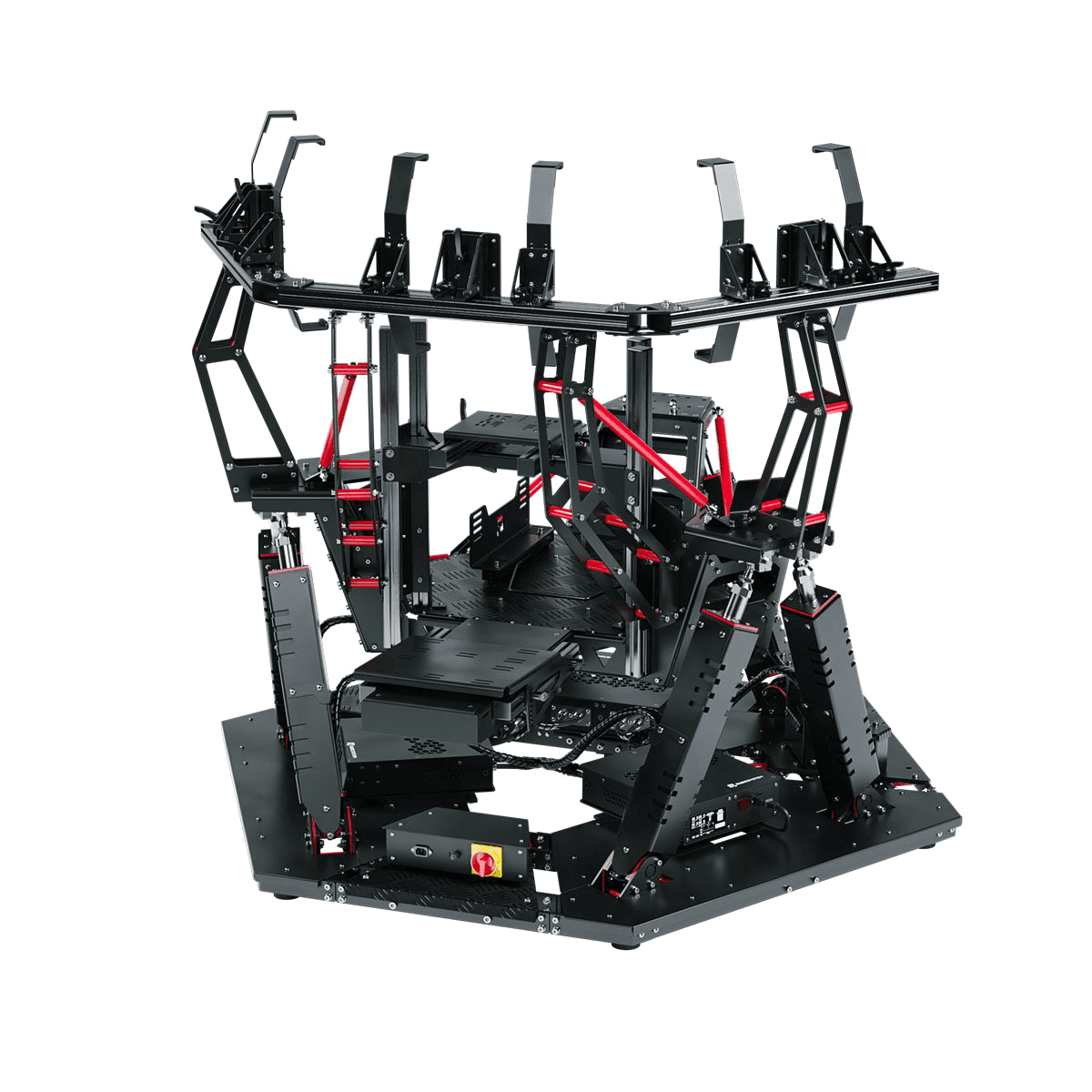
The pre-integrated rig.

On these rigs a modular VR or sim-racing cockpit is factory-calibrated to an embedded linear-actuator drive. Sub-8 ms end-to-end latency, plug-and-play software with 154+ supported titles. Built for compact professional simulators and guest-facing venues that need to open on time.

Payload
≤ 350 kg
DOF
2-6
Latency
< 8 ms
Explore QS Series
How each one works

Different mechanisms, different physics.

The mechanical principle behind each series sets the ceiling on what it can deliver. The headline numbers further down the page (payload, stroke, profile, noise) follow directly from the mechanism - not the other way around.

Ball screw · TL Series
TL · Linear Series

Direct rotary-to-linear conversion through the screw.

Each of the six legs is a precision ball-screw actuator. The servo motor drives the screw; the nut runs along it; the leg extends or retracts. The same mechanism used in CNC machines - force flows straight along the actuator axis with no crank or lever in the path. In a Stewart layout the six legs share the load, so every actuator contributes simultaneously to all six axes.

  • A toothed belt couples the servo to the ball screw, which converts that torque into axial force along the leg - so the PS-6TL-1500 carries 1350 kg of cabin without growing in plan area.

  • Vertical travel is independent of tilt - the ball nut can run the full screw length. PS-6TL-1500 delivers over 505 mm of vertical displacement for maritime, turbulence and heavy-cabin work.

  • Ball-screw backlash is minimal; combined with six load-sharing legs, the platform tracks motion commands with rigidity that does not degrade under sustained load.

  • The actuator must extend along the motion axis, which adds to the resting height. Floor anchoring is required across the line, and the room needs enough ceiling height.

Helical-bevel crank arm · TM Series
TM · Low-Profile Series

Rotary motion converted to lift through a crank-arm linkage.

The servo motor sits horizontally alongside the actuator, not vertically beneath it. It rotates a helical-bevel gear (worm gear on the two most compact models) that drives a crank arm; the crank arm pushes the upper frame up and down. The mechanism is fundamentally an angular pivot - wide angular travel comes naturally; long linear stroke does not. Because the motor is laid sideways, the system sheds a large share of installed height versus a comparable ball-screw hexapod.

  • Models start at 337 mm at rest. Critical for low-ceiling rooms, mobile container simulators, and shared-room training centers where a Stewart hexapod simply will not fit.

  • Low-Profile pivots reach a wide roll envelope - useful for VR rollercoaster content, orientation-heavy aircraft training, and motorsport pitch-and-roll cueing.

  • Gear meshing is intrinsically quieter than a long ball nut at speed. Models up to 1000 kg run with no oil-change routine - and every model runs on electric drives, not hydraulics.

  • Crank-arm geometry caps vertical displacement around 324 mm. Maritime and aggressive turbulence cues that depend on raw heave amplitude push the application toward the TL series instead.

Integrated cockpit or actuator kit · QS
QS · Qubic System

A complete rig, or a drive kit for an existing cockpit.

Qubic spans two build styles. Complete rigs (QS-V20, QS-S25, QS-S35) pair a rigid VR- or sim-racing-grade cockpit chassis with a linear-actuator drive built into the same product, engineered around a fixed center of gravity so the platform arrives factory-calibrated. Actuator kits (QS-210, QS-220) bolt the same drive onto an existing cockpit. Either way, power and USB in, ForceSeatPM up, and it runs.

  • Cockpit and motion base share a single mechanical reference. Vestibular cues stay synchronized with the visual scene, so motion registers as the scene moves rather than a beat behind it.

  • 154+ supported titles via ForceSeatPM, including iRacing, Assetto Corsa, MSFS 2024, X-Plane, DCS. New profiles ship with each software update - no SDK work required for off-the-shelf content.

  • Built for a full commercial duty cycle: steady back-to-back operation through the day, with a 54-59 dB(A) acoustic profile quiet enough for a perception or vestibular research lab and equally at home in a guest-facing venue.

  • On complete rigs the cockpit is part of the product. Custom cabins, full vehicle dynamics labs, and >350 kg payloads belong on TL or TM.

Compare the specs

Compare the three, spec by spec.

Tick the capabilities that matter and the table flags which series leads each. Most builds balance several - so weigh the trade-offs side by side, then use the scenario shortcuts below.

Tick what matters

Nothing selected yet - tick a capability above to spotlight the series that leads it.

Drive technology comparison across mechanism, capacity, site & ops and integration.
SpecificationTLLinear SeriesTMLow-Profile SeriesQSQubic System
Mechanism
Actuator typeBall-screw, direct pushHelical-bevel crank armEmbedded linear actuators
Kinematic architecture6-leg Stewart hexapod3DOF tripod or 6DOF low-profile2-6DOF, cockpit or actuator set
Force pathStraight along the actuator axisRotary → crank → linearStraight along the actuator axis, inside the cockpit
Capacity & motion
Payload range150-1350 kg150-1500 kgUp to 350 kg
Max heave strokeVertical (heave) travel - drives turbulence, curb and sea-state cues.505+ mmUp to 327 mmUp to 343 mm
Max angular range (roll)±21.2°±24.5°Model-dependent
Latency (end-to-end)Sub-30 msSub-30 msSub-8 ms
Structural stiffnessResistance to flex under load - underpins motion fidelity for R&D and certification.Highest - ball-screwHigh - crank-arm driveBuilt into the cockpit
Site & ops
Installed height at restProfile matters for low-ceiling rooms, mobile containers and retail venues.Tallest of the threeFrom 337 mmLow (cockpit-integrated)
Power supply120/230V single-phase on TL-150/250, 230V on TL-350; 400V 3-phase on the heaviest models230V on most models; 400V on heavier 6DOF / 1000 kg+120/230V single-phase
Floor anchoringRequired across the lineRequired across the lineFree-standing on most models
Lubricant serviceBall-screw oil, across the lineGear oil at 1500 kg onlyNone required
Acoustic profileIndustrial range (louder than QS)Low - gear meshing only54-59 dB(A)
Duty cycleContinuous, industrialContinuous, industrialShift-grade, commercial
Integration
CockpitCustomer-suppliedCustomer-suppliedIncluded on complete rigs
Software pathPlug-and-play profiles (PM), plus telemetry (MI) and direct-control (DI) SDKs.ForceSeatPM / MI / DI SDKForceSeatPM / MI / DI SDKForceSeatPM / MI / DI SDK
Typical lead time6-10 weeks6-10 weeks1-3 weeks

This is a starting point, not a quote - the exact payload, room, power and certification needs can change the pick. Worth a quick check with the team before committing.

Talk to the team
Quick pick by scenario

Match the project profile? Start here.

Skip the spec sheet. Pick the build closest to the project - each series shows where it wins and where it stops being the right call.

Choose TL when payload, rigidity or heave authority decide the project.

Six ball-screw actuators in a Stewart hexapod. Rigidity, payload and heave stroke are inherent to the mechanism.

Explore the TL series
  • Loaded cabin sits above 720 kg, or the project needs headroom toward 1350 kg.
  • Heave-dominant content: maritime sea-state, sustained turbulence, heavy R&D rigs.
  • Integrator certification path - FTD Level 2 / FNPT II, MIL-STD, EASA or DNV.
  • Rigid, low-backlash motion for vehicle-dynamics labs, neurorehabilitation, and perception research.
  • Site has 400V three-phase available and a concrete floor that accepts wedge anchor bolts.

Watch out: Below a 2.2 m ceiling, or where the floor cannot take anchor bolts, the TM line fits better.

Describe the project being built.

Quick question or a full simulator project - the team reads everything.

What happens next?

< 1 business day

Confirmation & initial review

A dedicated account manager reads the message directly.

2-3 business days

Technical assessment

The team analyzes feasibility and prepares questions or an initial concept.

5-10 business days

Proposal delivery

Detailed technical proposal with a platform recommendation, transparent pricing, lead time, and integration timeline.

Ongoing

Team support

Ongoing support from the team behind the recommended platform - for the life of the project.