
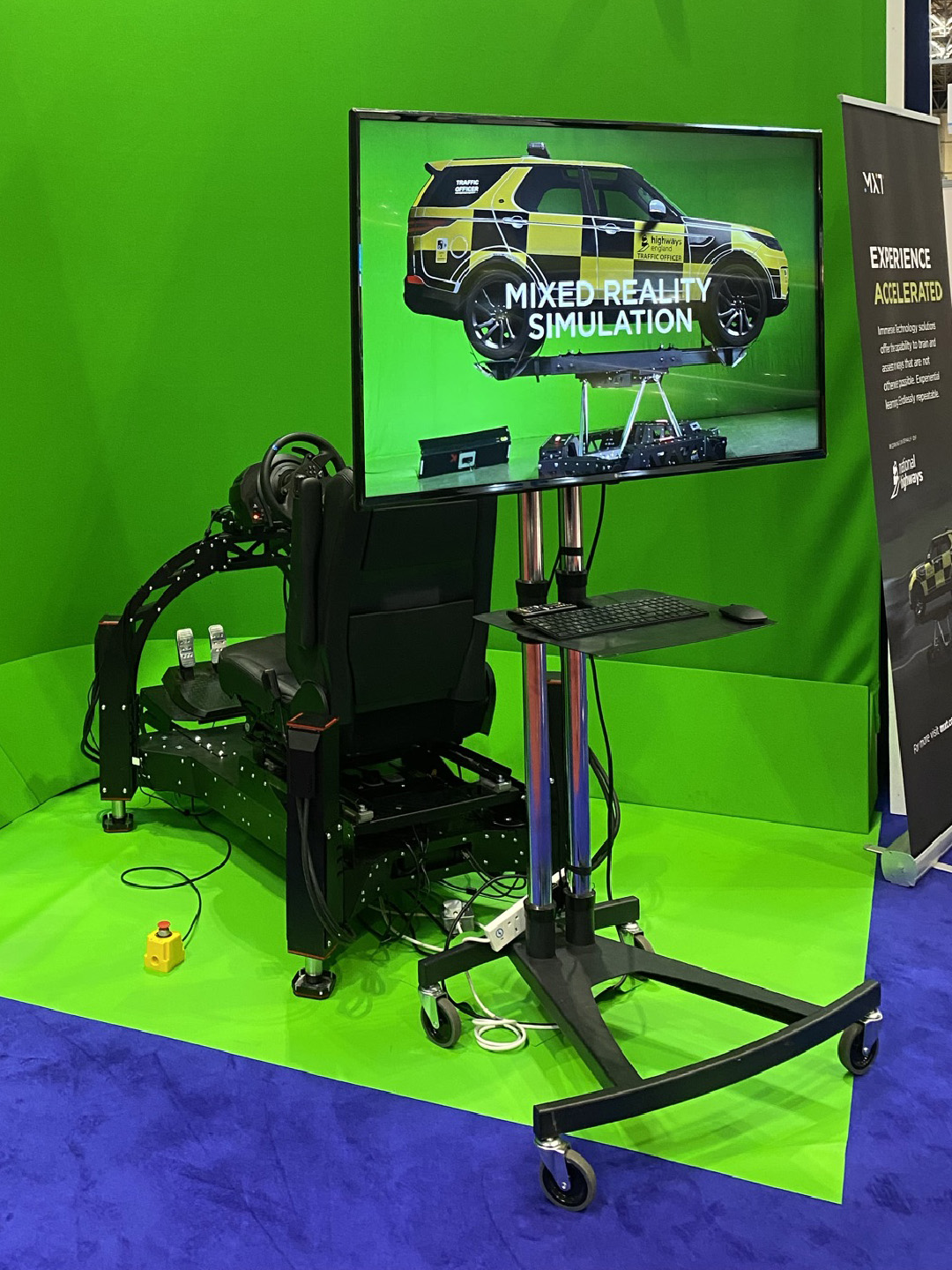
Mixed Reality Simulation
Birmingham, UK
The Solution
Pairing virtual reality with a motion platform gives emergency-service crews a safe, repeatable way to rehearse the road hazards they face on duty. Because of that, Highways England is always in need of training solutions that best prepare officers for what they might encounter in daily work. During the Emergency Services Show in Birmingham, both traffic officers and visitors had the opportunity to test a VR driver’s training vehicle simulator provided by MXT Reality with Varjo XR-3 Headset. In this simulator as a motion base, MXT used two QS-220 actuator sets (four electric linear actuators) configured for 3DOF, onto which the seat of a Land Rover Discovery was bolted, since this is one of the vehicles that Traffic Officers use.
MXT reports immersive learning up to four times faster. In the past, Highways England used conventional driving simulation, classroom education, and time on actual, albeit private, roadways. Under the guidance of Traffic Officer Trainers, they typically practiced basic maneuvers and processes in slightly different road conditions. Using the mixed reality simulator, MXT puts trainees through road sections drawn from anywhere in the world, editable on the fly. This training system includes all necessary elements to learn how to drive and react in fast-changing conditions. Additionally, instead of individual training simulations for individual scenarios, MXT used the Varjo XR-3 Mixed Reality headset, which blends the real cockpit with the virtual scene through pre-configured settings for the implementation of tasks, and by MXT's account, this approach shortens training time versus traditional lessons.
The key attributes of the simulator platform are:
- Mixed Reality Varjo XR-3 Headset - This enables the user to see their passenger, their vehicle, and themselves in the real world. When the user looks at the (CGI) rearview mirrors of the vehicle, they see a totally accurate reflection.
- Road Editor - MXT has created a road editor system. Using the system, the user can choose a section of road, from anywhere in the world. They can very quickly render it into the MR simulation.
- Motion Platform - The QS-220 is a compact motion platform built on electric linear actuators. In this build, two QS-220 actuator sets (four actuators in total) deliver 3DOF, moving the driver into the virtual world with the mapping of stimuli from the real world.
- Traffic System - The user can choose the traffic flow any time of day and any day (or night) of the year for their road section. The system draws from open-source traffic data and drops it into the simulation in real time.
- Environment Tool - MXT created a library of environmental assets in order to quickly sculpt an urban, semi-urban, or rural environment.
This driving simulator is a training tool that can be put together in a way that best suits the demands of everyday use. The user can select different road layouts, environments, times of day, traffic and roadside resources that are realistic for the selected location. The user has a sense of presence between the real and simulated worlds. Changes can also be made on the fly, from roadside signs to road cones, which can be assessed using the data collection built into the Varjo headset.
The contribution of those involved in training goes hand in hand with technology. MXT worked very closely with Traffic Officer trainers to understand what works best for training to ensure the simulator’s realism. Details are critical to the success of such a system and can only be understood by the people who do the work on a daily basis.
Project Gallery
A closer look at the build and installation.