
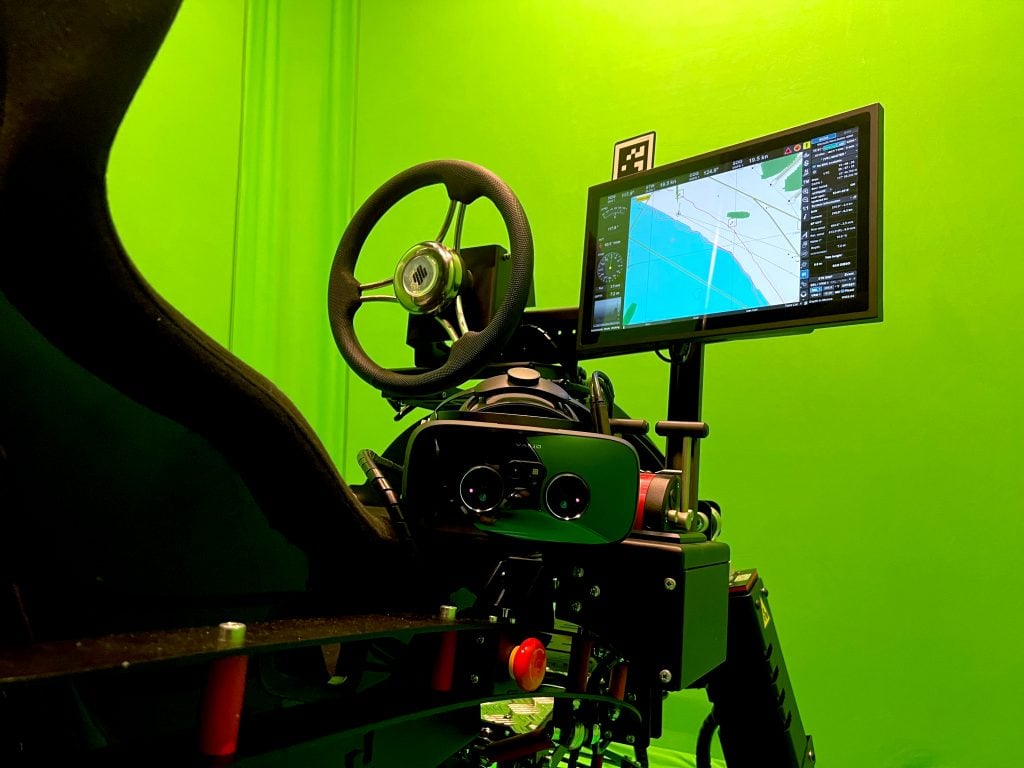
Wärtsilä Marine Small Boat Trainer
Finland
The Challenge
Maritime training has traditionally depended on large, expensive simulators built from multiple 2D screens and dozens of high-end projectors - installations that take weeks to deploy, occupy dedicated facilities and need continuous maintenance. A limited number of global training centers caps the hours and the number of trainees that can be put through. Earlier VR/XR attempts fell short: not enough visual quality, no view of the real controls, and no effective multi-user teamwork for scenarios such as bridge resource management (the crew-coordination drills run on a ship’s bridge).
- Projector-and-screen simulators take weeks to install and need dedicated halls
- Limited training centers cap available hours and trainee throughput
- High infrastructure and maintenance cost per station
- Earlier VR blocked the view of real controls and multi-user collaboration
The Solution
Wärtsilä, with more than 30 years in marine simulation and over 3000 simulator installations worldwide, set out to make high-fidelity seafarer training cheaper to deploy and easier to scale.
For the Marine Small Boat Trainer, Wärtsilä paired a physical cockpit with real controls and a QS-V20 motion platform with Varjo XR mixed-reality headsets. Two trainees sit in the physical cockpit while the headsets blend the digital sea state and environment with the real equipment in front of them through high-resolution video pass-through, real-time chroma keying and masking. The QS-V20 feeds the matching physical movement, so what the crew sees and what they feel stay in sync.
Mounting the cockpit on the QS-V20 was central to the result: accurate motion cues turn a visually convincing scene into a believable boat. The compact 4DOF platform delivers the heave, pitch, roll and yaw a small-craft trainee needs without the footprint, noise or power demands of a large simulator hall, which keeps the whole rig portable and quick to commission.
The outcome is a simulator that deploys in days rather than weeks, runs on a single GPU-powered PC per headset, and, per Wärtsilä, cuts visual-infrastructure cost by 40-80% versus a traditional projector-based setup - while raising immersion and training throughput.
Key Results
Early customer feedback confirms a positive return on investment and broader access to high-fidelity training across Wärtsilä's global network.
“Accurately replicating the sense of physical movement increases immersion and the effectiveness of training outcomes by a large degree.”
Project Gallery
A closer look at the build and installation.