A motion platform is a mechanical system that turns simulation data into physical movement, so the person inside a simulator feels what they see on screen. When the virtual car brakes hard, the platform pitches forward. When the aircraft hits turbulence, it delivers a short vertical jolt. That physical layer is the difference between watching a simulation and participating in one.
This article explains what a motion platform actually is, how it works, the main parts it is built from, and how to tell whether one earns its cost for a given project. It is written for anyone meeting the technology for the first time - a sim racer weighing a motion cockpit, an integrator scoping a training simulator, a researcher specifying lab equipment. The examples are drawn from two product lines that sit at opposite ends of the same idea: Qubic System, an industrial-grade compact line for sim racing, VR, driver training, and R&D, and the Professional Series for heavy cabins and professional training. Both are built by Motion Systems.
Key takeaways
- A motion platform converts telemetry into calibrated physical movement, not just vibration - the goal is sensory coherence between eyes and inner ear.
- The same four-step chain (telemetry, motion cueing, actuators, perception) runs whether the platform sits under a single seat or a full flight cabin.
- Motion earns its cost when training depends on physical skill transfer; for purely cognitive tasks, cheaper tools do the job better.
What does a motion platform do?
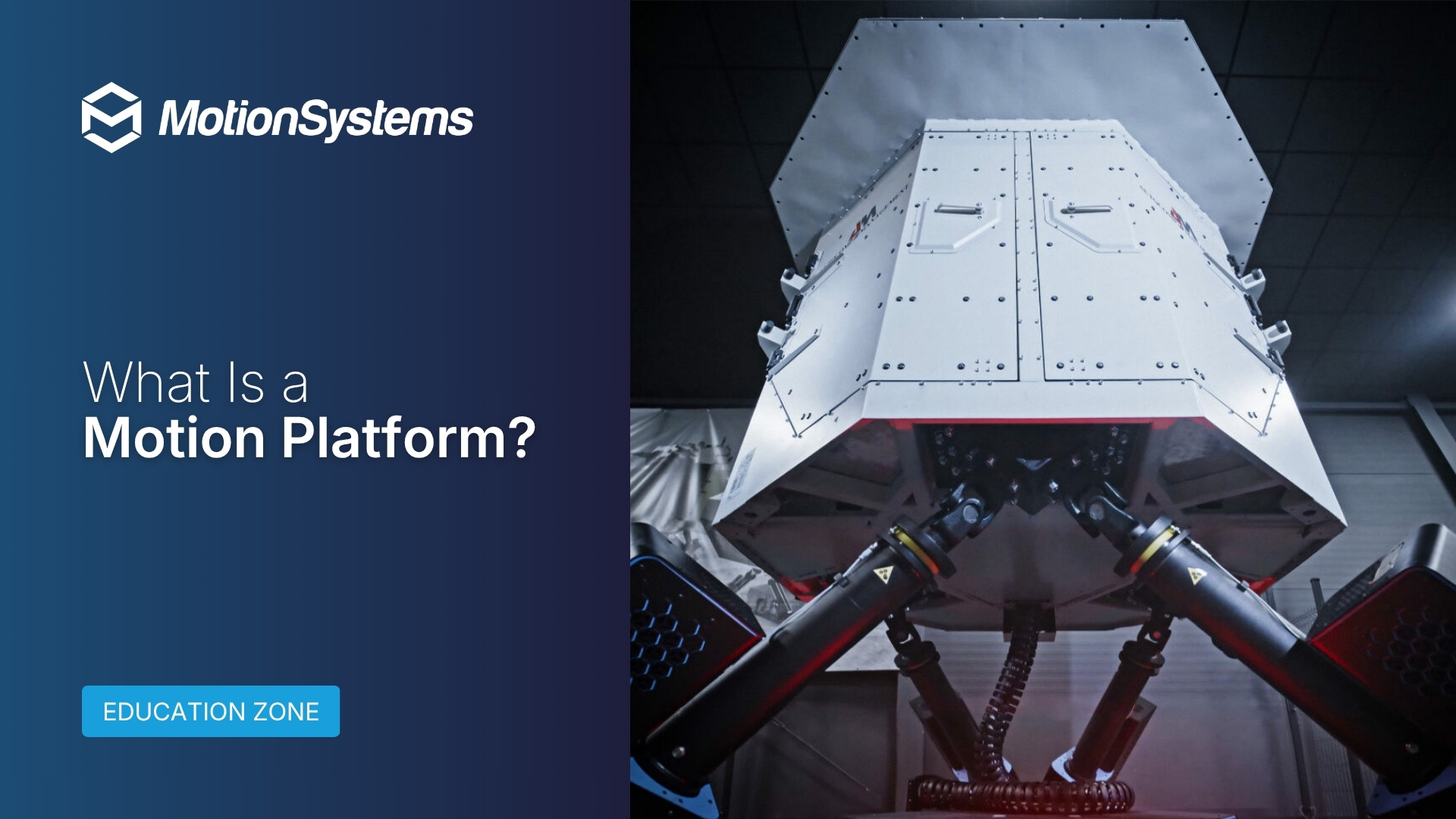
A motion platform reproduces the forces of real operation inside a simulator. It sits under the cockpit, cabin, or seat and moves the whole structure in response to what the simulation software calculates, so the body receives the same acceleration, tilt, and vibration cues it would feel in the real vehicle.
The body relies on those cues constantly. A driver tilts forward under braking. A motorcyclist leans into a turn. A pilot feels the airframe shudder before an aerodynamic stall. Those sensations are how the brain builds its model of what the vehicle is doing - the eyes read the scene, the body reads the forces, and a real operator uses both together. Strip the forces away and the simulator is just a screen. Add them back, accurately, and it starts teaching the body, not just the eyes.
Here is the distinction that trips up first-time buyers. A gaming chair with rumble motors also moves, but it produces buzz, not force. A true motion platform uses calibrated actuators that deliver controlled displacement at defined speeds, within set travel limits. The output is a force the inner ear interprets as real acceleration. Training researchers call the result sensory coherence: the eyes see one thing, the vestibular system feels the matching thing, and the brain accepts the experience as real enough to learn from. Everything else - actuator type, cueing software, payload ratings, every spec on a datasheet - exists to make that coherence reliable.
How does a motion platform work?
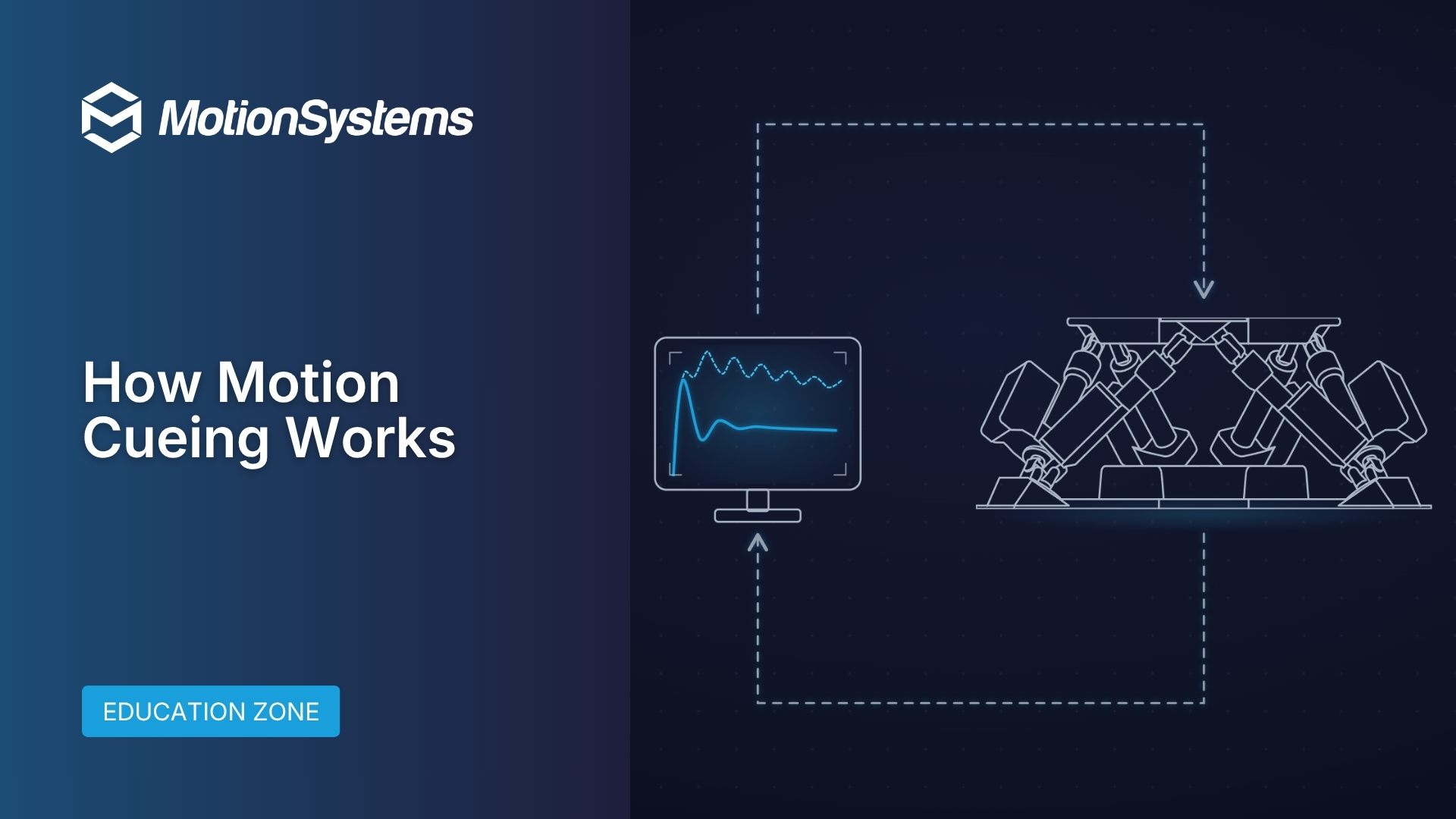
A motion platform works through a four-step signal chain that runs continuously while the simulator is active: telemetry, motion cueing, actuator execution, and perception. Each step shapes the final quality of the motion, and each is where weaker systems fall down.
Step 1 - Telemetry. The simulation software streams real-time data about the virtual vehicle: speed, acceleration, orientation, terrain contact, impacts. The refresh rate of that stream sets the ceiling for what the hardware can reproduce. A feed running at 100 Hz gives the platform ten times more detail per second than one at 10 Hz, which is the difference between a curb strike arriving as a smooth, reproducible curve and the same strike arriving as one blunt event.
Step 2 - Motion cueing. This is the hard part. A motion cueing algorithm translates large, sustained forces - a long banking turn, a highway sweeper - into shorter platform movements that stay inside the physical travel range. It also handles washout: easing the platform back to neutral between cues, slowly enough that the body does not notice the return. Washout is the reason a platform with a fixed stroke can suggest a turn that lasts far longer than its actuators could ever reach. Done well, the machinery stays invisible. Done poorly, every movement feels abrupt and artificial.
Step 3 - Actuator execution. The algorithm sends position commands to each actuator many times per second, synchronized to the visual display. Most modern professional platforms use electric servo actuators. The practical payoff: no hydraulic fluid, no warm-up cycle, instant start, quiet operation, and far lower long-term maintenance than fluid-based systems.
Step 4 - Perception. The operator receives forces aligned with the scene, and over repeated sessions the body builds muscle memory - anticipating brake balance, feeling the onset of a skid, recognizing the buffet that precedes a stall. That transfer of skill is the entire point of the chain.
Definition - motion cueing: the software that decides how a platform moves. Think of it as a real-time translator between the simulation and the hardware. The quality of this translation, more than the number of axes, separates motion that sharpens a skill from motion that only shakes the seat.
What are the main parts of a motion platform?
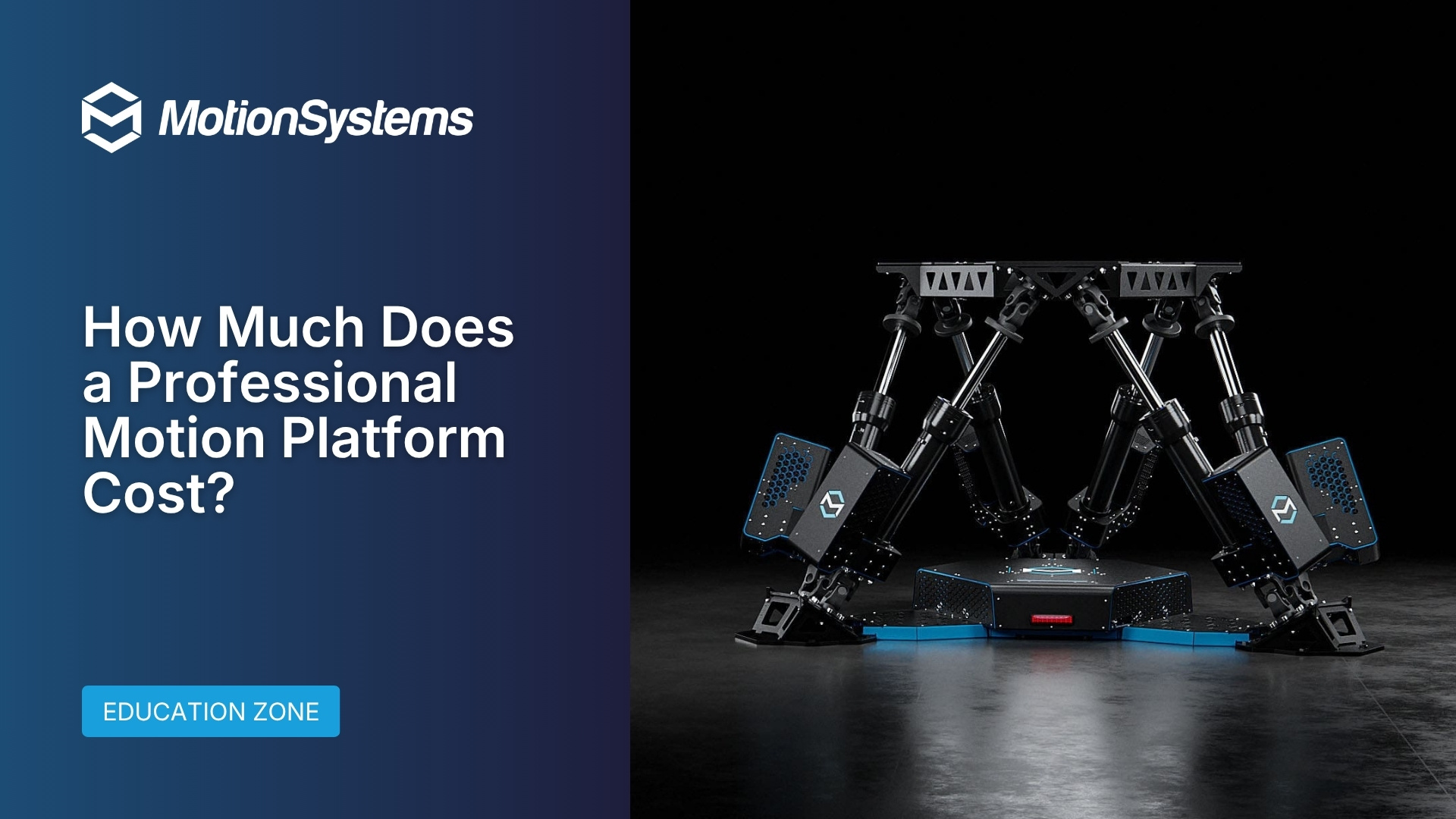
A motion platform is built from four core components: a frame, actuators, a controller, and motion software. The hardware looks different across product lines, but the building blocks are the same.
- Frame and mounting interface. The rigid structure that carries the cockpit and transmits movement into it. A flexing frame absorbs fine cues before they ever reach the operator, which is why structural rigidity matters as much as the actuators bolted to it.
- Actuators. The muscles. Electric actuators extend and retract on command to tilt, lift, and shake the platform. Their stroke length, peak velocity, and acceleration define the motion envelope - and these vary per model, which is why averaged marketing numbers are close to useless when comparing platforms.
- Controller. The hardware that takes cueing commands and drives each actuator in precise coordination, closing the loop hundreds of times per second.
- Motion software. The cueing algorithm plus the integration layer that connects to the simulation. On both Motion Systems lines this includes a free platform manager and a paid software development kit (SDK) for custom integration. The company supplies the platform, the control software, and the SDK - it does not sell finished turnkey simulators, which is a point worth understanding early, because the integrator or end user assembles the complete simulator around the platform.
How is motion synchronized with the visual scene?
Motion is synchronized with the visuals through latency - the end-to-end delay between an event in the simulation and the matching movement of the platform. Low latency keeps the felt motion locked to the seen motion; high latency pulls them apart, and the gap is exactly what makes people sick.
The number matters because of physiology, not marketing. When the eyes and the inner ear disagree, the nervous system reads the mismatch as something being wrong, and the result is nausea and disorientation. So response time becomes a hard design target rather than a bullet point. Across the Qubic System range, end-to-end latency runs below 8 milliseconds, measured end-to-end at full payload (the QS-H13 layered system runs below 10), fast enough that a sim racer feels the rear step out the instant the screen shows it. The Professional Series runs below 30 milliseconds end-to-end, measured, which keeps a full training cabin comfortably inside the threshold where motion stays an asset.
Without that synchronization the platform stops being a training aid and becomes a liability. A system that lags the visuals produces the very sensory conflict it was bought to resolve - the body feels the turn a beat after it sees it, the brain flags the error, and trainees start cutting sessions short. That is the loss a latency spec is really protecting against: not slow movement, but the sickness and lost training time that arrive when motion and vision drift apart.
What is the difference between a motion platform and a motion simulator?
A motion platform is the moving hardware; a motion simulator is the complete system built around it. The platform is one component. The simulator includes the cockpit or cabin, the displays or VR headset, the controls, the simulation software, and the platform underneath.
The distinction matters at procurement time. Buyers often compare a platform price against a full-simulator price and conclude one vendor is far cheaper, when they are simply pricing two different things. It also clarifies who builds what. Motion Systems supplies the platform plus control software and SDK; an integrator or the end customer combines that with the cockpit, visuals, and content to deliver the finished simulator. On the professional side this carries a regulatory consequence too: a Professional Series platform ships as partly completed machinery under the EU Machinery Directive (2006/42/EC) with a Declaration of Incorporation, and the party who assembles the finished simulator is the one who CE-marks it. Knowing the boundary up front prevents the most common scoping error - assuming the platform vendor delivers a ready-to-run simulator.
Types of motion platforms: from a single seat to a full cabin
Motion platforms span a wide range, usually described by how many independent ways they can move - their degrees of freedom (DOF) - and by the mass they are built to carry. More axes and more payload mean a larger, costlier machine, so the right type depends entirely on the task.
A useful way to see the range is to compare the two Motion Systems lines, which are built for different worlds:
| Qubic System (QS) | Professional Series (PS) | |
|---|---|---|
| Built for | Sim racing, VR, compact driving and training sims, R&D, defense part-task trainers | Heavy cabins, flight and vehicle training, defense, R&D |
| Typical DOF | 2-3DOF (QS-220), 4DOF with traction loss (QS-V20), 6DOF (QS-S25) | 3DOF low-profile (PS-3TM-200) to 6DOF (PS-6TM tripod-motor, PS-6TL Stewart hexapod) |
| Payload class | Single cockpit and driver | Up to a full cabin (PS-6TL-1500 carries a 1350 kg payload) |
| End-to-end latency | Below 8 ms (QS-H13: below 10 ms) | Below 30 ms, measured |
| Drive | Electric servo actuators | Electric servo actuators |
| Who buys it | Prosumers, sim-racing centers, OEM integrators | Integrators, training centers, procurement, universities |
The shared idea underneath both columns is the same: electric actuators, calibrated movement, software-driven cueing. What changes is scale. A 2DOF seat mover and a 6DOF hexapod carrying a flight cabin are the same category of device solving the same problem at very different sizes - which is also why a 6DOF platform is not automatically "better" than a well-tuned 3DOF. The better platform is the one that reproduces the sensations the task actually needs.
Common applications: who uses motion platforms?
Motion platforms are used wherever physical skill transfer matters - far beyond the flight simulators most people picture first. Flight training is the oldest and most visible application, but the technology now reaches across many industries.
- Aviation - pilot and aircrew training, from emergency procedures to type ratings.
- Driving and motorsport - driver training, racing academies, and sim-racing centers where lap-to-lap consistency depends on low latency.
- Defense - tank, armored vehicle, and tactical driving trainers.
- Automotive R&D - vehicle dynamics studies and driver-in-the-loop validation of new systems.
- Rail and maritime - train and ship handling, including emergency scenarios too risky to rehearse for real.
- Research and entertainment - vestibular and teleoperation studies, plus commercial VR and racing venues.
The duty cycle separates these worlds more than the hardware does. A rail training center running two simulators across two eight-hour shifts, five days a week, needs hardware rated for roughly 4000 operating hours per year per unit. A research lab might run a similar platform 200 hours a year. The machines can look identical on paper; the service intervals, spare-parts consumption, and total cost of ownership differ by an order of magnitude. The right choice tracks the operational reality, not the datasheet alone.
When does a motion platform earn its cost?
A motion platform earns its cost when the training goal depends on physical skill transfer, and it does not when the goal is purely cognitive. That single test answers the question more reliably than any spec comparison.
Motion makes sense when the task includes forces the body must learn to recognize - the buffet before a stall, the vestibular onset of a roll, the lateral load before a slide. It makes sense when sessions run long enough that simulator sickness limits throughput on a static setup, and it becomes more necessary, not less, when the simulator uses high-fidelity visuals or VR. That last point is the counterintuitive one most buyers miss: better visuals without matching motion tend to make sickness worse, because the image grows more convincing while the body still feels nothing. Paying for a sharp VR picture without motion can mean paying for the very cause of the nausea that then has to be managed.
And the honest other side. Motion is not a substitute for basic procedural training - checklists, system knowledge, radio protocol, decision trees. Those are cognitive skills a tablet or classroom delivers more cheaply and just as well. A project that buys motion to teach them ends up with an expensive machine doing work simpler tools do better. Motion is worth the money when the body has to learn something the eyes alone cannot teach. Match the hardware to that, and the rest of the decision gets a great deal calmer.
Frequently asked questions
What exactly is a motion platform?
A motion platform is a mechanical system that converts simulation data into calibrated physical movement, so the person inside a simulator feels the accelerations, tilts, and vibrations of the scene on screen. Unlike a rumble-equipped chair, it moves the whole cockpit through controlled displacement that the inner ear reads as real force.
What applications use motion platforms?
Aviation, driving and motorsport, defense, automotive R&D, rail, maritime, academic research, and commercial entertainment all use motion platforms. The common thread is physical skill transfer - any field where an operator must learn to feel and react to real-world forces, not just read a screen.
What is the difference between a motion platform and a full simulator?
The motion platform is the moving hardware; the full simulator is everything built around it - cockpit, displays or VR, controls, and simulation software. Motion Systems supplies the platform, control software, and SDK, while an integrator or end user assembles the complete simulator, so comparing a platform price to a turnkey simulator price compares two different scopes.
What components make up a motion platform?
A frame and mounting interface, electric actuators, a controller, and motion software. The actuators provide movement, the controller coordinates them precisely, the cueing software decides how the platform moves, and the frame transmits that movement into the cockpit without flexing it away.
How realistic is the motion a platform can produce?
Realistic enough to build genuine muscle memory, within physical limits. A platform cannot reproduce sustained g-force the way a real vehicle does - no ground-based system can - so motion cueing uses tilt and timed movement to let gravity simulate acceleration cues rather than sustained g-force directly, helping the body read actual motion within physical limits. Quality of the cueing algorithm and low latency matter more to realism than the raw number of axes.
How is the right motion platform chosen for a use case?
Start with the task, not the spec sheet. The first step is to define which sensations of real operation the training must reproduce, then match degrees of freedom, payload, and duty cycle to that answer and to the operating hours. An industrial-grade compact line such as Qubic System fits sim racing, VR, driver training, and R&D; the Professional Series fits heavy cabins and professional training. The right platform is the one that reproduces the relevant sensations at a cost the program can sustain.