A professional motion platform costs roughly the price of a mid-range car at the entry level and the price of a comfortable apartment at the flagship end, with most professional systems landing below the six-figure threshold for the platform and its power cabinet. That is the short answer. The longer answer is that the headline number means very little until it is broken into the factors that move it - degrees of freedom, payload, drive architecture, and what the quote actually includes.
This article explains what drives the price of a professional motion platform, gives realistic budget ranges by configuration, and draws the line between the cost of the platform itself and the cost of the finished simulator built around it. It is written for the people who have to put a number in a budget before the first vendor call: integrators scoping a training simulator, procurement officers preparing a tender, technical leads sizing a first project. The figures here are platform-class ranges, not a price list - exact pricing depends on the model and the project, and the only accurate number comes from a quote. The examples are drawn from the Professional Series, the heavy-cabin line built by Motion Systems, with the compact Qubic System line - the industrial-grade motion system for compact simulators, VR builds, driver-training and R&D - referenced where it sets the lower boundary of the market.
Key takeaways
- A professional motion platform plus its power cabinet typically runs from the low double-digit thousands of euros at the 3DOF entry level to the upper double-digit thousands for a flagship 6DOF Stewart, staying below the six-figure threshold across the standard catalog.
- Degrees of freedom and payload class are the two largest price drivers; a 6DOF Stewart carrying a full cabin costs many times what an entry 3DOF carrying a single seat does.
- The platform is one fifth to one third of a finished simulator's bill of materials, so a platform quote and a turnkey quote are two different numbers that buyers routinely confuse.
How much does a professional motion platform cost?
A professional motion platform, supplied as the platform and its power cabinet, generally falls into three budget bands. Entry-level 3DOF platforms on standard single-phase power start in the low double-digit thousand euro range. Mid-range 3DOF and low-profile 6DOF configurations for medium cockpits and training cabins sit in the mid double-digit thousand euro range. Flagship 6DOF Stewart platforms for full cabins, military programs, and heavy-payload research sit in the upper double-digit thousand euro range - still below the six-figure threshold even at the top of the standard catalog.
A few things narrow those bands into an actual number. Pricing is part of the first technical conversation, not a catalog lookup, because the recommendation depends on cabin weight, installation space, and the training objective. Custom and special-purpose builds sit outside the catalog ranges entirely - their price tracks the engineering scope, and a bespoke platform for an unusual cabin geometry or an extreme payload can run well beyond a catalog flagship.
For orientation, the table below maps the three bands to representative Professional Series models. The euro figures are class ranges for planning, not quotations.
| Budget band | Typical configuration | Representative models | Power | Class range (platform + cabinet) |
|---|---|---|---|---|
| Entry | 3DOF low-profile, single seat or station | PS-3TM-200, PS-3TM-350 | 230V single-phase | Low double-digit thousand EUR |
| Mid-range | 3DOF heavy or 6DOF low-profile, medium cockpit | PS-3TM-550, PS-6TM-550, PS-6TL-800 | Mix of single- and three-phase | Mid double-digit thousand EUR |
| Flagship | 6DOF, full cabin - Stewart (TL) or low-profile (TM) | PS-6TL-1500, PS-6TM-1500 | 400V three-phase | Upper double-digit thousand EUR, below six figures |
Tip: Any single price seen online is the start of a range, not the answer. Two platforms with the same number in the model name can differ in price because the number often encodes gross moving load, not net payload - the PS-6TL-1500 carries a 1350 kg payload; the 1500 in the name is gross moving load. Pricing follows the real capability, not the label.
Why are professional motion platforms expensive?
Professional motion platforms are expensive because the price pays for engineering that has to be right every time a human sits on a moving structure, not just for steel and motors. A platform that lifts a 700 kg cabin through coordinated movement, synchronized to a visual scene within tight tolerances, for thousands of operating hours, is a precision industrial machine. The cost reflects four things a datasheet rarely separates.
The first is mechanical and control engineering. Electric servo actuators, a controller closing the loop hundreds of times per second, and a cueing engine that decides how the platform moves - that stack took years to develop and is what separates calibrated force from a chair that shakes. The second is build quality rated for duty cycle. A platform running two shifts a day in a commercial training center is engineered to a different standard than a hobby kit, and that standard costs money up front to avoid costing far more in downtime later. The third is payload capability, which scales price steeply, for reasons the next section covers. The fourth is the support structure behind the machine - in-house manufacturing, spare-parts supply across the operating life, and engineering reachable when something goes wrong years into a deployment.
Here is the distinction that reframes the whole question. A low purchase price often hides cost rather than removing it. A platform with thin documentation can consume six to twelve weeks of unbudgeted integration engineering, erasing the saving before the simulator runs a single session. Without the engineering, support, and build quality the price pays for, the buyer inherits the cost as downtime, integration overruns, and an early replacement - the apparent bargain becomes the expensive option by year three. That is the loss the higher price is actually protecting against.
What factors drive the price of a motion platform?
The price of a motion platform is driven mainly by degrees of freedom and payload, with drive architecture, power class, and duty-cycle rating as secondary multipliers. Understanding which lever moves the number lets a buyer scope a budget that matches the task instead of overspecifying.
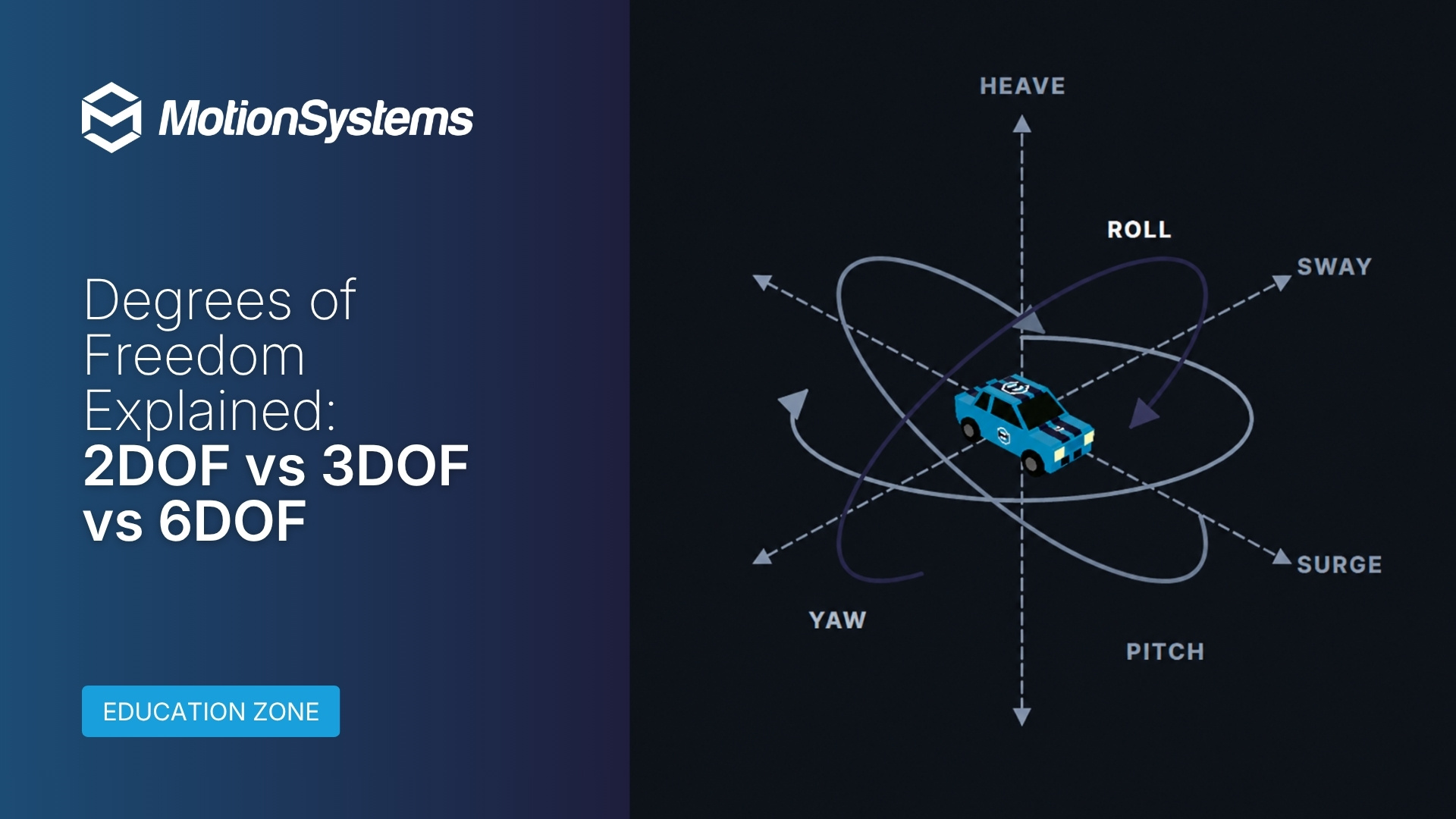
- Degrees of freedom (DOF). More independent axes mean more actuators, a more complex controller, and more sophisticated cueing. A 2DOF or 3DOF platform is materially cheaper than a 6DOF in the same payload class. More axes is not automatically better - a well-tuned 3DOF often outperforms a poorly calibrated 6DOF, so paying for axes the task does not need is paying twice.
- Payload class. This is the steepest driver. A platform built to move a 1350 kg cabin (PS-6TL-1500) needs far stronger actuators, structure, and drives than one built for a 200 kg station (PS-3TM-200). Payload also pulls in the power class - heavier platforms move from single-phase 230V to three-phase 400V, which adds a dedicated electrical run to the installation cost.
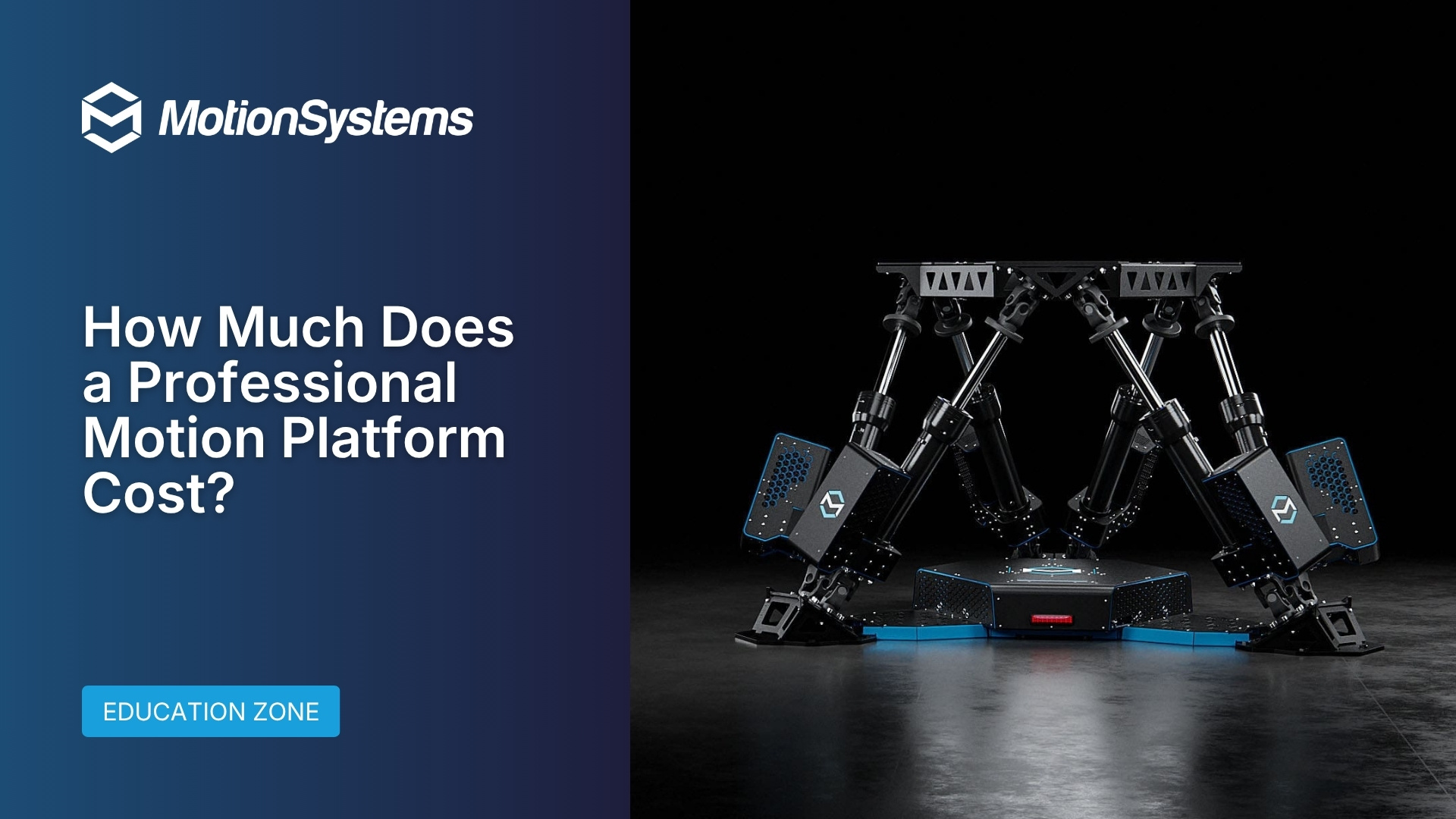
- Drive architecture. A Stewart (TL) platform with six ball-screw legs delivers the longest vertical travel and highest velocity, and prices accordingly. A low-profile (TM) platform using helical bevel gears tilts through wider angles in a lower, lighter package, often at a different price point in the same payload class. Neither is better in the abstract; they solve different problems.
- Duty cycle and build standard. A platform rated for thousands of hours a year in commercial use is engineered above one intended for occasional lab work, and that rating is priced in.
- Custom versus catalog. A standard catalog model carries standard pricing. A bespoke build for an unusual cabin, an asymmetric load, or an extreme envelope carries engineering, non-standard components, and a longer acceptance process - all of which raise the figure.
Definition - gross moving load (GML): the total mass a platform moves, which in some model names (the 6TL series) is the number in the model itself rather than the net usable payload. The PS-6TL-800 carries up to 720 kg net. Reading GML as net payload is one of the most common ways buyers misjudge both capability and price.
Platform price versus full simulator price
The platform is one component of a simulator, so a platform price is not a simulator price - and confusing the two is the single most common scoping error in motion procurement. The platform and its power cabinet are what the motion supplier quotes. The finished simulator includes the cockpit or cabin replica, the visual system or VR headsets, the controls, the simulation software, the instructor station, and the integration labor to make it all work together.
As a planning ratio, the motion platform represents somewhere between one fifth and one third of the total bill of materials for a typical turnkey training device. An integrator translating a platform price into a customer quotation multiplies the platform cost by three to five for an order-of-magnitude figure, then refines it line by line as the specification develops. Skip that step and the budget is wrong by a factor that no later negotiation can fix.
This boundary also carries a regulatory consequence on the professional side. A Professional Series platform ships as partly completed machinery under the EU Machinery Directive (2006/42/EC), with a Declaration of Incorporation, and the party who assembles the finished simulator is the one who CE-marks it. The motion supplier delivers the platform, the control software, and the SDK; the integrator or end customer builds the simulator around it. Knowing that up front prevents the assumption that the platform vendor hands over a ready-to-run device - and prevents comparing a platform quote against a competitor's turnkey quote and drawing the wrong conclusion about which is cheaper.
What is in the quoted price, and what is not?
A motion platform quote typically covers the platform, its power cabinet, the control software, and the documentation needed to integrate it - and typically excludes everything required to turn it into a working simulator. Reading a quote correctly means knowing both sides of that line before comparing two offers.
Usually included with a professional platform: the mechanical platform, the power cabinet, the control software (ForceSeatPM, the platform manager, is supplied free), firmware, and integration documentation. The software development kit for custom integration (the Motion Interface and Direct Interface SDKs) is a separate, one-time purchase per platform rather than a bundled item - a detail worth confirming in the first conversation, because an integration-heavy project depends on it. Commercial terms matter as much as scope: professional platforms are quoted net, EXW the Nadolice Wielkie facility in Poland, so shipping, duties, and local installation are the buyer's to plan. Payment is commonly staged - a deposit at order confirmation with the balance tied to agreed delivery milestones, settled in the quotation - rather than financed through leasing.
Usually not included, and budgeted separately: the cabin or cockpit replica, visual systems, simulation software licenses, the instructor station, integration labor, on-site installation, operator training, and extended warranty service. Two further planning facts belong in the timeline rather than the price: production lead time for a Professional Series platform runs 6 to 10 weeks from order confirmation depending on model and production load, and a buyer who submits a project description through the contact form typically receives a recommendation and a budget range within 1 business day. Professional Series warranty cover runs 24 months, with extended cover of up to five years available, matched to the platform and the project.
Where the entry-level market begins: the compact line
The lower boundary of the motion market sits well below the Professional Series, in the compact segment, which is useful context for any buyer calibrating a budget. Where a professional platform is built for heavy cabins and multi-shift training, the compact Qubic System line - also built by Motion Systems, on the same engineering and software stack - is an industrial-grade motion system for single cockpits, compact VR and driving simulators, driver-training academies, R&D labs, and OEM integration, and it prices accordingly. For many compact-simulator projects up to its heavy-duty payload envelope, it is the preferred fit rather than a scaled-down professional platform.
A compact entry platform such as the QS-210 starts as a set in the low single-digit thousand euro range, scaling to the QS-V20 all-in-one 4DOF cockpit at around 19500 EUR and the QS-S25 6DOF Stewart cockpit in the 29500 to 34900 EUR range. The two lines share the same ForceSeat software ecosystem and SDK, so a project can start compact and move up to the Professional Series later without changing supplier or relearning the integration. In plain terms, the price gap between the compact line and the professional line is not arbitrary - it tracks payload, duty cycle, and the engineering rated for heavy, continuous, professional use. A compact training or sim-racing center and a defense training program serving crews are buying for different jobs, and the price follows the job. The distance is real: a compact-simulator venue equips its bays with single cockpits, while a deployed program such as the Entrol Sikorsky S-64 firefighting trainer or the Obrum Leopard tank driver trainer is built around a full Professional Series platform - same supplier, two ends of the budget.
Frequently asked questions
What is a realistic budget for a professional 6DOF motion platform?
A professional 6DOF platform with its power cabinet generally runs from the mid double-digit thousand euro range for a low-profile or compact-payload configuration up to the upper double-digit thousands for a flagship Stewart carrying a full cabin, staying below the six-figure threshold across the standard catalog. The exact figure depends on payload class, architecture, and power requirements, so the reliable number comes from a project-specific quote rather than a list price.
Does the platform price include software and the controller?
Yes for the controller and the platform manager software, which are part of the platform; not necessarily for the integration SDK. The control hardware and the free platform manager come with the platform, while the Motion Interface and Direct Interface SDKs for custom integration are a separate one-time purchase per platform. Confirm SDK scope in the first conversation if the project requires custom software integration.
Why does a higher payload increase the price so much?
Because payload is the steepest cost driver in the entire specification. A platform built to move a heavier cabin needs stronger actuators, a stiffer structure, larger drives, and often a jump from single-phase to three-phase power, which adds installation cost. Each of those scales the price, which is why a flagship high-payload platform costs many times an entry single-seat unit.
Is the listed price for the platform only or the full simulator?
A motion platform price covers the platform and its power cabinet only. The finished simulator - cabin, visuals, controls, simulation software, instructor station, and integration labor - typically costs three to five times the platform price. Comparing a platform quote against a full-simulator quote compares two different scopes and is the most common budgeting mistake in motion procurement.
Why are professional platforms so much more expensive than DIY motion kits?
Because the two are engineered for different jobs and different lifespans. A DIY or hobby kit is built for occasional personal use; a professional platform is rated for heavy payloads and thousands of operating hours a year, backed by in-house manufacturing and long-term spare-parts support. The price difference reflects build quality, duty-cycle rating, and the support structure - costs that surface anyway, as downtime and early replacement, when they are absent.
How do I get an accurate quote for my use case?
Start with a short project description - intended application, rough cabin or cockpit weight, available installation space, and power availability - and submit it through the supplier's contact form. For a Professional Series platform the team typically responds within 1 business day with a recommendation and a budget range. Bringing a realistic payload estimate and target application to that first conversation produces a far more accurate figure than any catalog range.