Degrees of freedom describe the independent ways a motion platform can move in three-dimensional space, and a motion simulator uses them to turn a flat screen into a physical experience. A car brakes and the body pitches forward. It corners and rolls into the turn. It crosses a curb and heaves upward. Each of those is a separate degree of freedom, and together they decide whether a simulator teaches the body or only the eyes.
This article explains the six axes in plain terms, what each DOF count reproduces, and why the most common first-project question - how many degrees of freedom a project actually needs - has a less obvious answer than the number suggests. The examples come from two product lines that solve the same problem at different scales: Qubic System, an industrial-grade compact motion system for sim racing, VR simulators, driver-training and R&D builds, and the Professional Series for heavy cabins and professional training. Both are built by Motion Systems.
Key takeaways
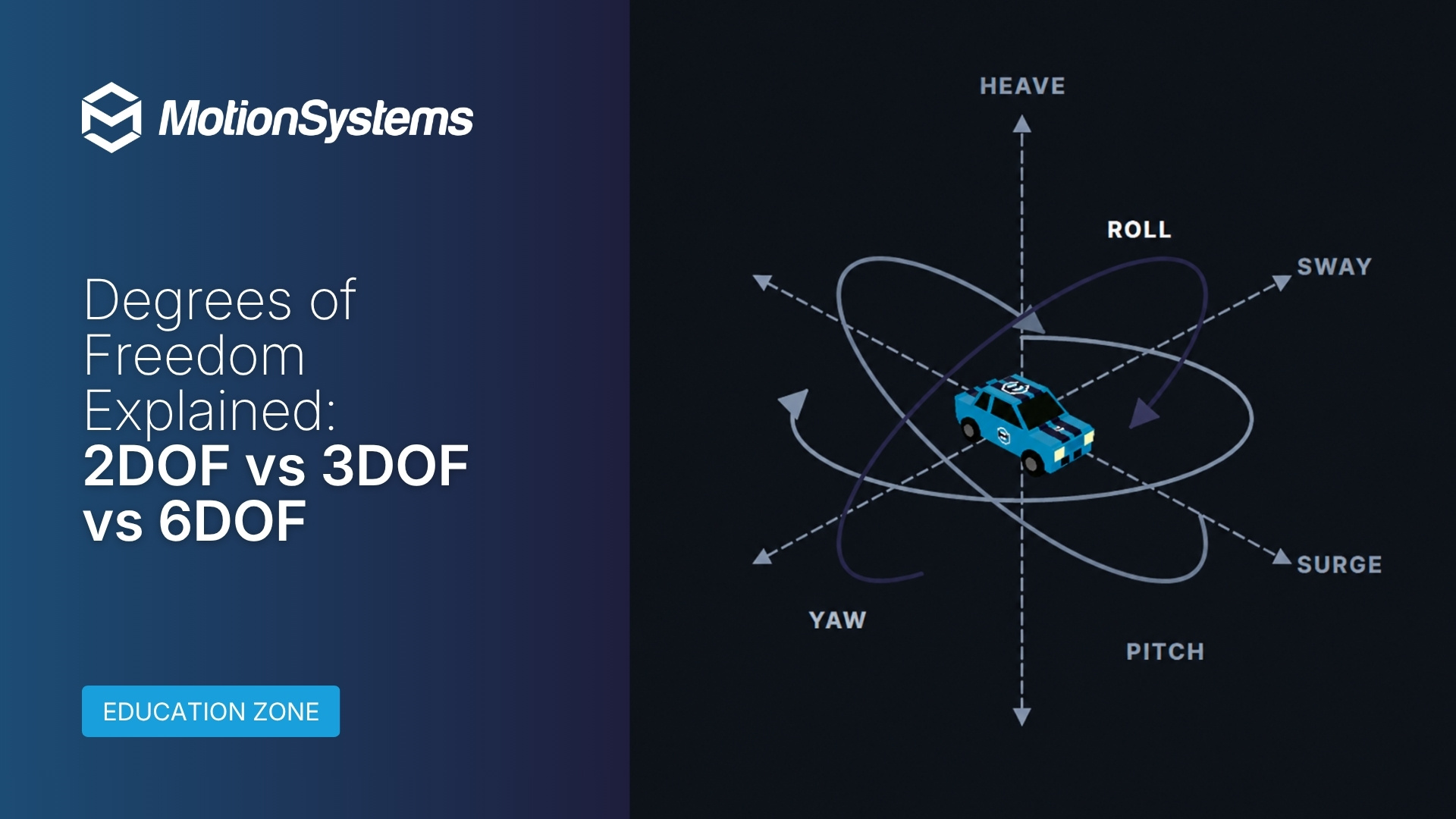
- Degrees of freedom split into three translational axes (surge, sway, heave) and three rotational axes (pitch, roll, yaw); a 6DOF platform reproduces all six.
- The right DOF count tracks the training task, not prestige. A well-tuned 3DOF platform often beats a poorly tuned 6DOF one.
- DOF count says which axes move. It says nothing about cueing quality, latency, payload, or duty cycle - the specs that decide how good the motion actually feels.
What does degrees of freedom mean in a motion simulator?
Degrees of freedom, usually abbreviated DOF, describe the independent ways a rigid body can move in space. In motion simulation those movements fall into two families, and every platform is defined by which ones it can reproduce.
Translational movements move the whole body along a straight line:
- Surge - forward and backward along the longitudinal axis, the way a vehicle accelerates or brakes.
- Sway - side to side along the lateral axis, the way a car slides in a skid or drifts in a crosswind.
- Heave - up and down along the vertical axis, the way a vehicle rises over a curb or drops into a pothole.
Rotational movements tilt or turn the body around an axis:
- Pitch - tilting forward and backward, the way a head nods "yes."
- Roll - tilting side to side, the way a head leans toward a shoulder.
- Yaw - rotating around the vertical axis, the way a head turns to say "no."
Together those six axes define the full motion envelope of a rigid body. A 6DOF platform reproduces all six. A 3DOF platform reproduces three, typically pitch, roll, and heave. A 2DOF platform reproduces two, usually pitch and roll. Each step down the ladder trades motion completeness for lower cost, smaller footprint, and simpler integration.
Definition - body-axis convention: professional motion engineering places the longitudinal axis nose to tail, the lateral axis left to right, and the vertical axis up and down, following the vehicle-dynamics standard ISO 8855. Some aerospace texts swap two of the axes. That swap does not apply here, so when comparing supplier specifications, confirm the convention matches before assuming pitch and roll mean the same thing on both sheets.
What is the difference between heave, surge, and sway?
Heave, surge, and sway are the three translational axes, and the simplest way to keep them apart is by direction: heave is vertical, surge is front to back, sway is side to side. They are easy to confuse because all three slide the whole cockpit rather than tilt it.
In a driving context the distinction is concrete. Heave is the jolt of a curb or a speed bump. Surge is the push into the seat under hard acceleration and the pull forward under braking. Sway is the lateral slide when the rear steps out in a drift. In flight, heave is the drop of an air pocket, surge is the thrust change of the engines, and sway is the lateral nudge of a crosswind. Same three axes, different forces, identical geometry.
The reason this matters for buyers is that translational axes are the expensive ones. Adding heave, surge, or sway requires actuators that physically move the platform through space, not just tilt it, which is why platforms below 6DOF almost always drop the translational axes first and keep the rotational ones. Knowing which slide a project actually needs keeps a specification honest.
What does each DOF count deliver?
Each DOF count reproduces a defined slice of the motion envelope, and the table below maps the common configurations to what a trainee feels and where each one fits. This is the single most useful mental model to carry into a vendor conversation.
| Configuration | Axes delivered | What the trainee feels | Where it fits |
|---|---|---|---|
| 2DOF | Pitch, Roll | Tilt during turns, acceleration, and braking | Multi-station centers where space and budget favor quantity. VR entertainment pods. Basic procedural driving |
| 2.5DOF | Pitch, Roll, partial Heave | Adds curb impacts and road texture; roughly 70-80 percent of the 3DOF sensation with actuators at the rear and a pivot leg in front | Cost-effective stations with a clear upgrade path to full 3DOF |
| 3DOF | Pitch, Roll, Heave | Full vertical cues and detailed road-surface feedback | The workhorse of professional simulation: fleet driver training, ground-vehicle trainers, education |
| 4DOF | Pitch, Roll, Heave, Yaw | Traction loss and torque effects in sharp turns; rotational cues for crosswind and rudder | Advanced driving centers, sim racing with traction loss, coordinated-turn flight training |
| 5DOF | Pitch, Roll, Heave, Yaw, partial Surge or Sway | Linear thrust and a strong sense of braking | Setups that pair a cockpit platform with a separate traction-loss layer |
| 6DOF | All six | The complete envelope: lateral sliding alongside vertical and rotational cues | Certified flight training devices, automotive R&D, military tactical trainers, research, maritime bridge |
A useful way to see the range in real hardware is to compare the two Motion Systems lines, which build these configurations for different worlds. On the compact side, the QS-220 delivers 2-3DOF for a single cockpit, the QS-V20 reaches 4DOF including traction loss using a chain kinematic that needs only four actuators, and the QS-S25 is a full 6DOF Stewart platform for sim racing. On the professional side, a low-profile PS-3TM-200 covers 3DOF for heavier rigs, while a Stewart hexapod such as the PS-6TL-1500 carries a full cabin at 1350 kilograms net across all six axes. Same idea, very different scale.
Can a 3DOF platform feel like 6DOF?
A 3DOF platform can convincingly suggest motion it cannot physically produce, because the inner ear can be fooled within limits. This is the trick that makes fewer axes go further than the number implies, and it rests on a technique called tilt coordination.
Here is how it works. No ground-based platform can reproduce a sustained g-force the way a real vehicle does - there is nowhere for the cabin to keep accelerating. So instead of producing the force directly, the platform tilts. By pitching back slightly during acceleration, it uses real gravity to press the body into the seat, and the inner ear reads that pressure as forward thrust. A well-tuned 3DOF platform borrows pitch to fake surge and borrows roll to fake sustained lateral load. The brain fills in the gap.
The catch is that this only works if the timing is right and the cueing is good. Tilt coordination that moves too fast becomes a false cue the body notices, and a noticed cue breaks immersion harder than no cue at all. So yes, a 3DOF platform can feel remarkably complete for the right task - but the credit belongs to the motion cueing software, not the axis count.
Does more DOF always mean better immersion?
More DOF does not automatically mean better immersion, and in some projects the assumption that it does leads buyers straight to the wrong platform. Three practical reasons explain why the catalog number is the wrong place to start.
First, cueing quality matters more than axis count. A well-tuned 3DOF platform driven by a quality motion cueing algorithm outperforms a 6DOF platform running a generic washout filter. The cueing is what translates raw telemetry into smooth, coherent movement. A platform with four extra actuators but a weak algorithm produces unconvincing motion across all six axes, which means the buyer pays for hardware that makes the experience worse, not better. Without good cueing, extra axes add cost and risk rather than realism.
Second, complexity scales with axis count. A 6DOF hexapod has six actuators to maintain, six signal paths to calibrate, and six potential fault points. For a center running the simulator eight hours a day across a full year, that difference shows up directly in service intervals, spare-parts inventory, and total cost of ownership. A 3DOF platform with four actuators carries lower lifecycle complexity, and when the task does not need the extra axes, that simplicity is a clean advantage rather than a compromise to defend.
Third, the right configuration tracks the task, not the spec sheet. A driver-training center focused on emergency braking, cornering awareness, and curb response is training pitch, roll, and heave - exactly what a 3DOF platform reproduces in full. Adding yaw, surge, and sway expands the envelope without expanding the training value for that use case. There is one important exception: certification. A full flight simulator certified to a regulated level requires 6DOF because the certification specification mandates it. That is a regulatory answer, not an engineering one, and it is a different kind of decision from "does the trainee need to feel this."
Key takeaway: The better platform is the one that reproduces the sensations the task actually needs, within the duty cycle the program can sustain, at a cost it can support for years. Sometimes that answer is 2DOF, often 3DOF, occasionally 6DOF. The task decides, not the catalog.
Which DOF axes matter most for sim racing versus flight?
Racing and flight prioritize different axes because the two activities put different forces in front of the operator. Racing lives on short, sharp cues; flight lives on smooth, sustained ones. The underlying physics is identical, but the training meaning diverges.
For sim racing and driver training, pitch, roll, and heave carry most of the information. Pitch communicates weight transfer under braking and acceleration so the driver anticipates grip changes. Roll reproduces body lean in corners so the driver reads the limit of adhesion. Heave delivers curb strikes and road texture. Yaw becomes valuable a step up, because it signals the rotational instability of oversteer the instant the rear breaks away - the cue that lets a driver catch a slide. This is why a sim-racing path can run convincingly from a 2-3DOF QS-220 up to a 6DOF QS-S25 depending on how much the build chases that last slice of fidelity.
For flight training, the same axes shift in meaning. Pitch sets climb and descent attitude. Roll enables coordinated turns. Heave reproduces turbulence and air pockets. Surge and sway gain weight here relative to driving, because thrust changes and crosswind correction are core flight skills, and yaw becomes essential for rudder work and helicopter coordination. A flight cabin that trains crosswind landings benefits from the translational axes a driving rig can often skip.
The lesson holds across both: the axes that matter are the ones carrying the forces the operator must learn to read. Everything else is footprint and cost.
What DOF count does not tell the buyer
The DOF number answers exactly one question - which axes the platform moves in - and a procurement process that treats it as the primary selection criterion is answering the wrong question first. Several specifications that decide motion quality are invisible in the DOF count:
- Motion cueing quality. The algorithm that turns telemetry into movement is not summarized by axis count. Two 3DOF platforms with identical actuators can feel completely different depending on the cueing engine driving them.
- End-to-end latency. The delay between a simulation event and the matching platform movement is a separate spec entirely. Across the Qubic System range it runs below 8 milliseconds (the QS-H13 layered system below 10), and the Professional Series runs below 30 milliseconds end-to-end, measured. Above the perception threshold, motion stops reinforcing the scene and starts causing sickness.
- Actuator velocity and stroke. Two platforms labeled "3DOF" can have very different heave strokes and peak velocities, and those numbers determine what the platform can actually reproduce.
- Payload and inertia. A platform rated for 200 kilograms behaves differently from one rated for over a thousand, even at the same DOF count - and how the mass is distributed matters as much as the total, because a tall cabin demands far more actuator torque than a low one of the same weight.
- Software ecosystem. The SDK and integration layer decide how quickly an integrator delivers a working simulator. None of that lives in the DOF number.
- Duty cycle and service life. Rated operating hours, maintenance schedule, and spare-parts availability separate a machine that survives commercial use from one that does not. The DOF count is silent on all of it.
The primary question is which sensations the training must reproduce. The DOF count falls out of that analysis naturally, alongside cueing, latency, payload, software, and duty cycle.
Frequently asked questions
What does DOF stand for in a motion platform?
DOF stands for degrees of freedom - the independent ways a platform can move in three-dimensional space. There are six in total: three translational (surge, sway, heave) and three rotational (pitch, roll, yaw). A platform's DOF count indicates which of those six axes it can reproduce.
What is the difference between 3DOF and 6DOF?
A 3DOF platform reproduces three axes, typically pitch, roll, and heave. A 6DOF platform reproduces all six, adding yaw plus the two remaining translational axes, surge and sway. The practical difference is that 6DOF can produce lateral sliding and rotational cues a 3DOF platform can only suggest through tilt coordination, at the cost of more actuators, higher price, and greater maintenance complexity.
Is 6DOF required for realistic motion?
Not usually. Most driving and many flight tasks are reproduced convincingly by a well-tuned 3DOF platform using good motion cueing. 6DOF becomes necessary when the task requires lateral and rotational cues together, or when a certification standard mandates it. For a typical sim-racing or fleet-training build, cueing quality and low latency matter more to realism than the extra axes.
Which DOF axes matter most for racing versus flight?
Racing relies most on pitch, roll, and heave for weight transfer, body lean, and curb feel, with yaw adding traction-loss cues. Flight relies on the same rotational axes for attitude and coordinated turns but gives more weight to surge and sway for thrust and crosswind, and treats yaw as essential for rudder work. The axes that matter are the ones carrying the forces the operator must learn to read.
Can a 3DOF platform feel like 6DOF?
Within limits, yes. Through tilt coordination, a 3DOF platform uses gravity to mimic sustained acceleration and lateral load, so the inner ear reads forces the platform never physically produces. It cannot reproduce true simultaneous lateral sliding, but for many tasks the perceived difference is small. The result depends almost entirely on the quality of the motion cueing software rather than the axis count.
How is the right number of degrees of freedom chosen?
Begin with the task, not the spec sheet. The first step is to list the sensations the training must reproduce, then match the axes to that list and to the operating hours the program will run. An industrial-grade compact line such as Qubic System fits sim racing, VR, and compact training and R&D builds from 2-3DOF up to 6DOF; the Professional Series fits heavy cabins and professional training. The right answer is the configuration that reproduces the relevant sensations at a cost the program can sustain.