
Motion Simulator Add-Ons.
Effect modules that create a physical cue without moving the platform - force applied to the occupant directly rather than to the cockpit, driven from the same controller and software as our motion bases. They layer onto a platform you already own, or bring a physical cue to a rig that has none.
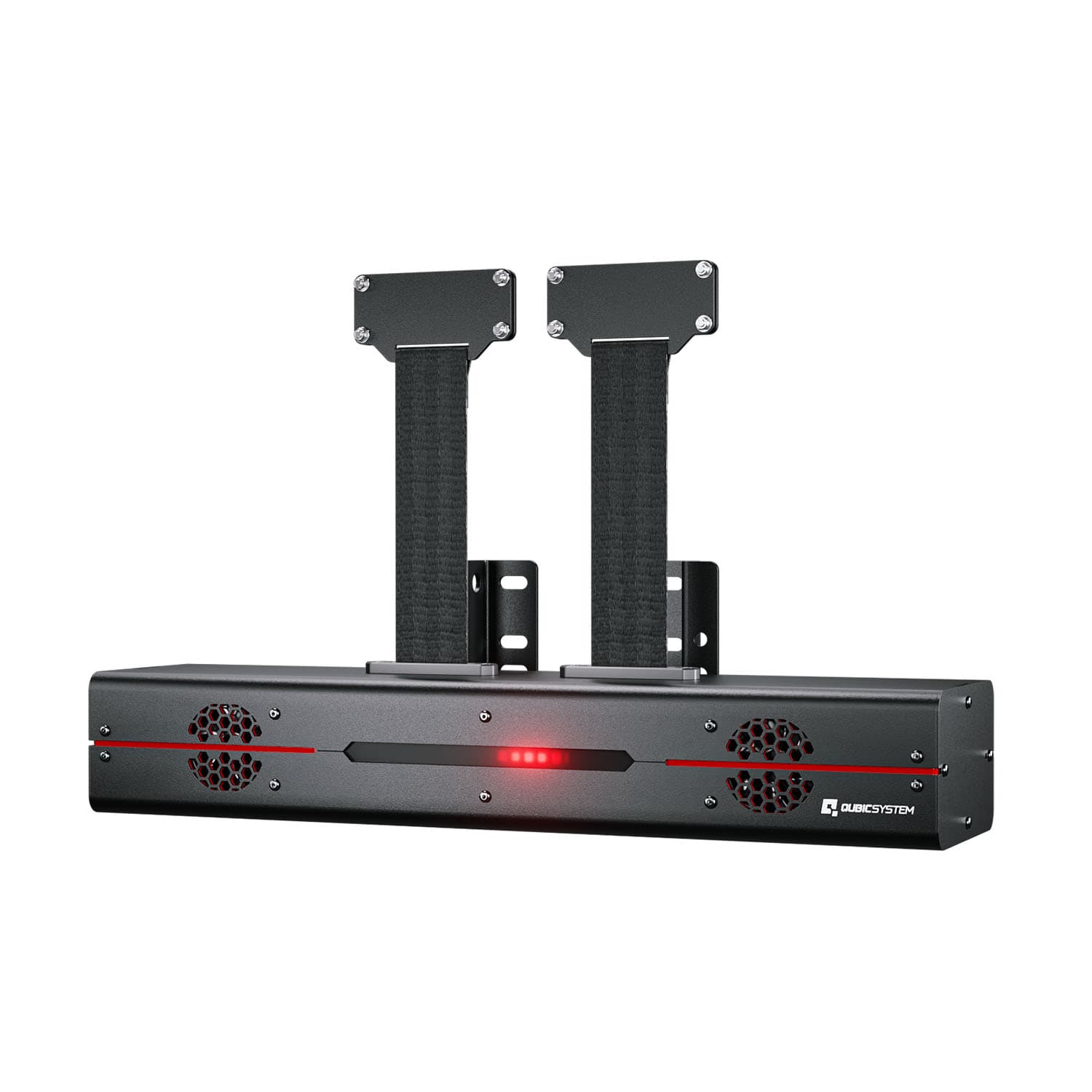
QS-BT1
€1 390Qubic System
A belt tensioner that pulls the seat harness for braking and load cues, with no startup calibration. Quiet, 40 W on a household outlet, and layers onto any QS or PS platform.
Cues that do not need an axis
Not every motion cue has to come from moving the cockpit. A platform reproduces acceleration by displacing the occupant; an add-on applies force to the body directly. Under braking a belt tensioner pulls the harness into the chest - the same loading a real deceleration delivers through the belts - with no axis travel at all.
That makes add-ons additive rather than an alternative. On a motion platform they cover the sustained-load and high-frequency ends that an axis with finite stroke cannot hold. On a static rig they are the cheapest way to put a physical cue into a simulator that has none, and they install without the floor preparation or the clearance radius a platform needs.
Everything here runs from the same controller and software as our motion bases, so an add-on specified later does not introduce a second toolchain or a second operator workflow - and the grid above always shows the current range, whichever effect modules it contains.
Motion Simulator Add-Ons - common questions.
What comes up most often when a project is being specified around this axis count.
An add-on has no rated degree of freedom. It does not displace the cockpit along or about an axis - it applies force to the occupant or the frame directly. That is why these products sit on their own page instead of among the 2DOF to 6DOF platforms: ranking them by axis count would say nothing useful about what they actually do.
No. It runs from the same controller and software as our platforms, but it works just as well on a static rig. On a platform an add-on contributes a cue channel the axes cannot cover; on a static rig it is often the entire motion effect, at a fraction of the installed cost.
Yes. The QS-BT1 layers onto any QS or PS platform and needs no startup calibration, so adding one does not disturb an installation that is already commissioned. It runs from a standard household outlet rather than a dedicated supply, which usually means no electrical work either.
A transducer shakes the seat to convey surface texture and engine feel - high frequency, low force. A belt tensioner pulls the harness, which the body reads as sustained load: braking, weight transfer through a corner, g-loading in flight. They sit at different ends of the cue spectrum, and the QS-BT1 covers both, with two independent channels and the vibration range listed in its spec table.
Not sure which platform is right?
The Configurator walks through five parameters - payload, DOF, drive technology, infrastructure, and software integration - to narrow the field.
Describe the project being built.
Quick question or a full simulator project - the team reads everything.
What happens next?
Confirmation & initial review
A dedicated account manager reads the message directly.
Technical assessment
The team analyzes feasibility and prepares questions or an initial concept.
Proposal delivery
Detailed technical proposal with a platform recommendation, transparent pricing, lead time, and integration timeline.
Team support
Ongoing support from the team behind the recommended platform - for the life of the project.