
Naming Conventions
Reference guide for naming conventions - ship motion names, force names, sustained vs. intermittent terminology.
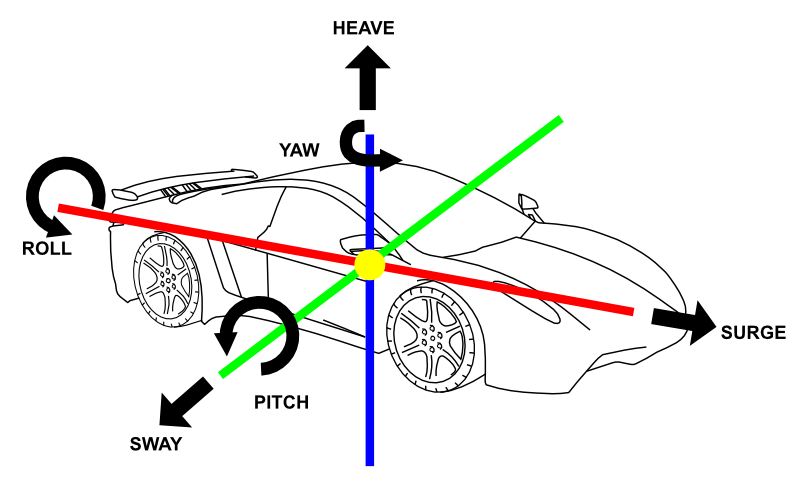
1 Motion names
In order to avoid confusion caused by different type of XYZ coordinate systems used by different applications (e.g.left-hand rule, right-hand rule, ISO 8855, etc), platform manager uses ship motion names.
2 Forces names
Following drawing shows names of the forces (accelerations) and angular velocities that affect the vehicle.
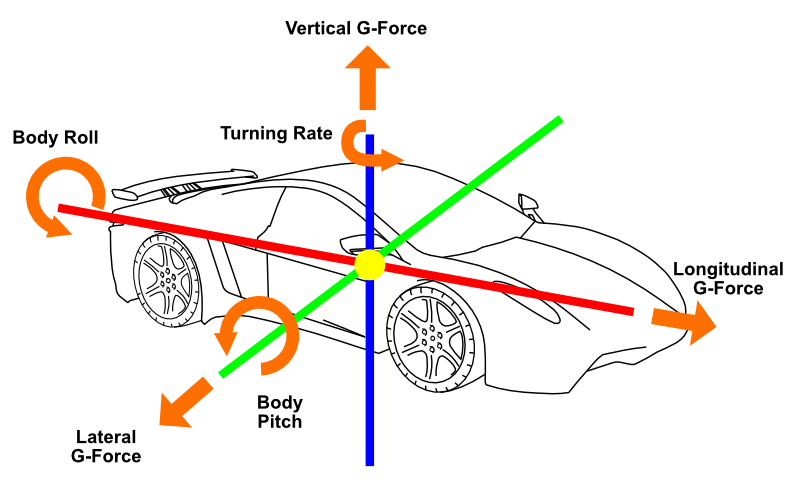
Body Roll is a relative constant angle related to track surface (e.g. hills) or angular velocity (roll rate) that represents intermittent vehicle body rotation. The latter is usually meaningful only in flight simulators. The first case is controlled by Body Roll (Intermittent) quick tune, the second case by Body Roll (Sustained) quick tune.
Body Pitch is a relative constant angle related to track surface (e.g. hills) or angular velocity (pitch rate) that represents intermittent vehicle body rotation. The latter is usually meaningful only in flight simulators. The first case is controlled by Body Pitch (Intermittent) quick tune, the second case by Body Pitch (Sustained) quick tune.
Turning Rate is a rotation rate (angular velocity) among vertical axis and it is controlled by Turning Rate quick tune.
3 Sustained vs intermittent
Longitudinal/Lateral G-Force (Intermittent) defines how the motion platform responds to changes in linear accelerations. The result is a surge/sway motion and then the motion platform goes back to the center position (washout). These two options are available only on devices that support surge and sway, e.g. 6DoF.
Longitudinal/Lateral G-Force (Sustained) defines how the motion platform responds to sustained (long-term) linear accelerations. In order to simulate a long-term acceleration, the Earth's gravity is used. The motion platform performs pitch/roll and stays in that position as long as the linear acceleration is valid.
Vertical G-Force (Intermittent) defines how the motion platform responds to changes in vertical acceleration. The result is a heave motion and then the motion platform goes back to the center position (washout). If the motion platform does not support pure heave, then it is remapped to pitch.
Vertical G-Force (Sustained) defines how the motion platform responds to sustained (long-term) vertical acceleration. In order to simulate a long-term acceleration, the Earth's gravity is used. The motion platform performs pitch and stays in that position as long as the linear acceleration is valid. This option is used only in flight simulators.
| Name | Source | Output | ||
| Body Roll (Sustained) | → | vehicle roll | → | roll (long-term) |
| Body Roll (Intermittent) | → | vehicle angular velocity | → | roll (short-motion) and return to neutral |
| Body Pitch (Sustained) | → | vehicle pitch | → | pitch (long-term) |
| Body Pitch (Intermittent) | → | vehicle angular velocity | → | pitch (short-motion) and return to neutral |
| Turning Rate | → | vehicle angular velocity | → | yaw (short-motion) and return to neutral |
| Longitudinal G-Force (Intermittent) | → | linear longitudinal acceleration | → | surge (short-motion) and return to neutral |
| Longitudinal G-Force (Sustained) | → | linear longitudinal acceleration | → | pitch (long-term, usage of gravity) |
| Lateral G-Force (Intermittent) | → | linear lateral acceleration | → | sway (short-motion) and return to neutral |
| Lateral G-Force (Sustained) | → | linear lateral acceleration | → | roll (long-term, usage of gravity) |
| Vertical G-Force (Intermittent) | → | linear vertical acceleration | → | heave (short-motion) and return to neutral |
| Vertical G-Force (Sustained) | → | linear vertical acceleration | → | pitch (long-term, usage of gravity) |